


“Bow down before the one you serve,
you’re going to get what you deserve.”
Nine Inch Nails
Introduction by Terry Zwigoff
June 4th, 1999
After my film Crumb was released in 1995, I was spending a lot of time in Los Angeles, trying to get the money to make another movie. Late on a Friday afternoon after a really horrible time waster of a day spent in pursuit at several “important” meetings, I found myself once again at LAX a little more beaten down than even the week before (if that were possible). This film business is tough. Everyone is eager to talk about making films; no one, it seems, wants to actually make one. It takes courage and that’s hard when they don’t seem to know what’s good and what’s bad; they don’t even trust their own judgement.
I only had an hour flight home to SF but I couldn’t handle it without something to read, and after those meetings I just couldn’t stomach the latest issue of “Premiere” and “Entertainment Weekly” I’d brought along for the flight home. I had five minutes to find something else at the newsstand before boarding. I saw a copy of Below the Line, opened a page at random and read something truthful about the film business, and because it was so true, seemed incredibly funny to me. If I could get one or two such laughs out of the rest of the book, I’d be happy, I thought. I bought the book and didn’t put it down (except for the cab ride home) until I finished it later that night, countless laughs later. What a great book! This guy Helton could be the next Bukowski! A couple of days later I was on the phone trying to track down two more copies to send to some friends of mine. No luck—no store seemed to carry the title. Finally, I wrote the publisher trying to buy a few more—some publisher I’d never heard of in the middle of nowhere in Texas.
Days later I got a call from the author, J.R. Helton. He was thrilled anyone liked the damn thing. He only had four copies left, he’d self-published only 1,000 copies, and somehow they were all sold out. He offered to sell all four to me (he was really broke), but I convinced him to keep one for himself. I sent him money for the other three, and lamented the fact that such a terrific book was out of print. Surely, he could get some publisher interested, couldn’t he? Nope, he’d been through it too, it seemed. None of the publishers or agents he’d sent it to thought there was enough Movie-Star gossip in it to make it commercial enough. Add some Sex and Drugs and Gossip and they’d be more interested. Either that, or make it more “upbeat” somehow! I told J.R. I’d call around and see what I could do.
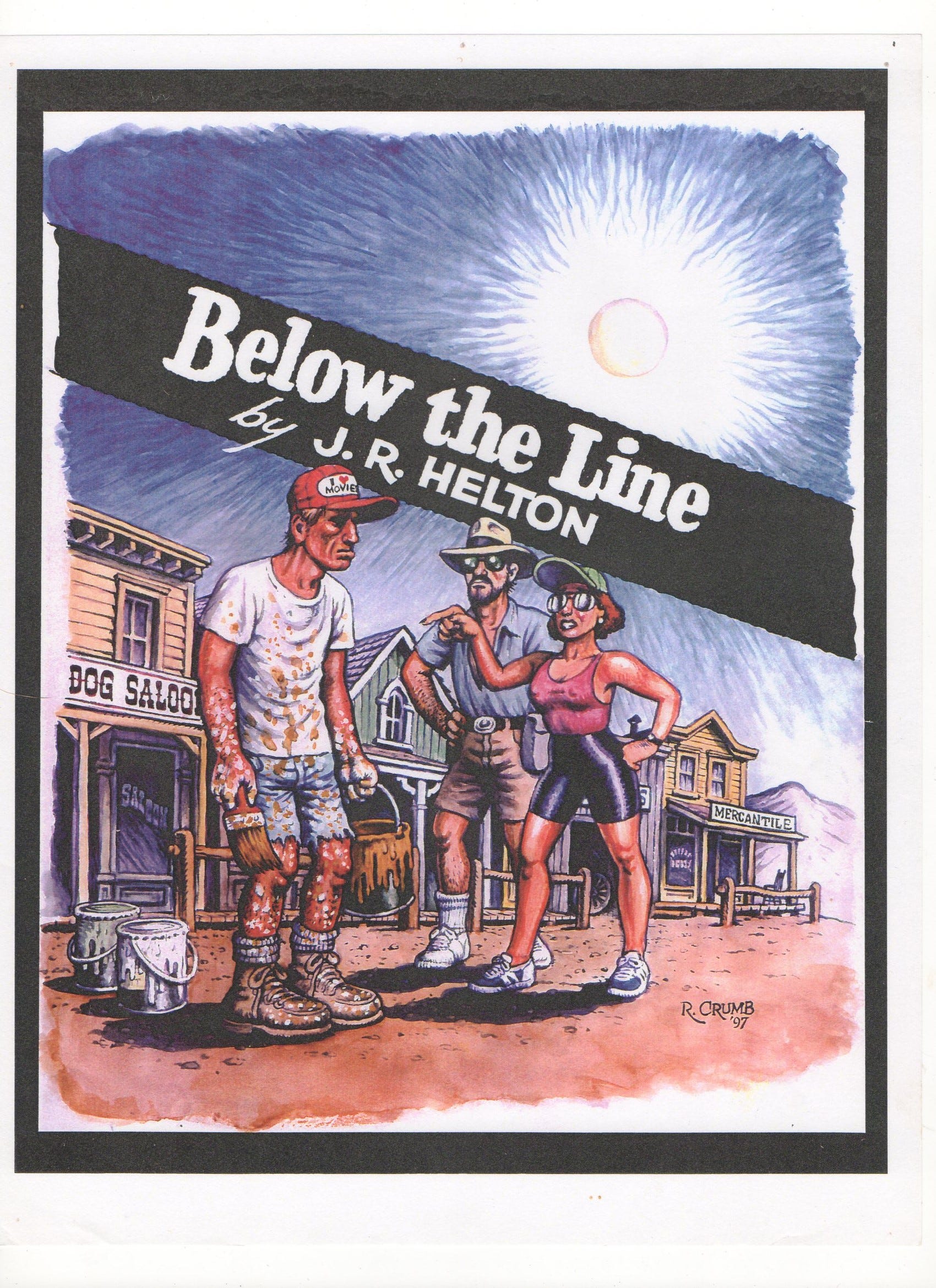
Meanwhile, Robert Crumb showed up at my house for his annual visit. He found the book on my couch and also couldn’t put it down. The next day he offered to paint a new cover for free in hopes that would interest some publisher enough to publish it. A month later he sent me the painting he’d slaved over for a week, and I started contacting prospective new publishers. They were all dutifully excited of course. They all loved Robert’s work, my films, etc. etc. They all couldn’t wait to see the book and the new cover.
One after another they turned Helton down. “It’s too negative,” “too critical,” “too downbeat,” too this, too that. Crumb and I even had dinner with an old acquaintance of ours in an attempt to get him to take it on (John Martin of Black Sparrow Press). All through the meal Robert browbeat him into having the courage to publish the book. (This was something most out of character for Robert to do, by the way). Finally, three bottles of wine later, we had a deal. A deal that lasted until the next day when the publisher called and made up some excuse why he couldn’t do it. At least this guy could give us a “no.” All the others stalled us with, “Well, I loved it, but the other two partners have to read it also,” or, “I have it on my desk—I’ll try to get to it next month.” Clearly, none of these pampered cake-eaters would have the foresight to publish William Faulkner if he weren’t already famous.
However, Robert took the book to Ron Turner who publishes some of his comics at Last Gasp Publishing here in SF. Ron agreed to publish what you know hold in your hands. To his credit, Ron told J.R. on the phone, “It won’t be the first book I’ve published without reading.”
Terry Zwigoff
Publisher’s Note: However, Terry, I read this one and was only disappointed when the damn thing ended. I wanted more of Helton’s surgical insights and jarring observations. I’m sure you readers will agree.
---Ron Turner
---1---
I was on the final location scout that went through Happy Shahan’s Alamo Village in Brackettville, Texas before filming began on Aaron Spelling’s television/video production of James Michener’s Texas. Mr. Spelling was footing the bill for the history of my state. Mr. Shahan was providing much of the backdrop we would be using.
John Frick, the production designer, who is in charge of the art department, which is responsible for the look of the sets on a film, asked me to come along on the scout as I was his lead scenic, or set painter, and would be doing a lot of work on Alamo Village to transform it into the several towns it would represent in the various shoots.
There were ten or twelve of us following the director, a tall, obese man I knew only as Rich, like a flock of ducklings. Like most location scouts, it was boring. Rich walked around making wisecracks, looking at all the different buildings Happy had to offer, deciding things like where Jim Bowie would have his Memphis knife-fight, how many friars and children the banditos would shoot when the mission was raided, and where to erect the Austin Capitol flagpole, consulting with his new designer Frick on the last question.
“So, John, where do you think the flagpole should go?” Rich asked, stopping the group in front of the projected Austin Capitol.
There was a long silence. Frick took off his cowboy hat and rubbed a shaking hand nervously over his sweating bald head. “Well...”
More silence. “We could put it up on the roof ...or...down in front here...”
My boss said nothing, staring at the building again, as Rich waited.
After thirty seconds of silence, Rich gave up. “I guess we can decide that later. Let’s move on,” he said, and we all dutifully followed through the oppressive Texas heat. I didn’t think of it as a portentous moment.
Alamo Village was constructed by John Wayne and company back in the late 1950’s for the film The Alamo. It consists of a replica of the Alamo, including its original surrounding walls, and a town comprising several streets lined with adobe, stucco, and Old-West style buildings. Mr. Shahan has since turned the village into a large tourist trap and monument to “The Duke,” whose unremarkable likeness can still be seen all over town in the form of cardboard cut-outs, statuettes, and framed prints of his giant head hovering ominously over a western landscape. There is even a John Wayne museum tucked away between the town’s many curio shops. There’s also a Johnny Rodriguez museum. All varieties of European and Asian tourists can be seen wandering and sweating through the hot, dusty streets of Alamo Village, perhaps wondering what brought them to a place that could easily be on the receiving end of a giant magnifying glass held in the sun by a malicious god.
At the hot light’s center was Happy Shahan. Happy the legendary cowboy had done it all: a champion basketball player at Baylor University in the thirties, a successful, large ranching operation, personally convincing John Wayne to shoot his film on Happy’s 20,000-acre ranch, and then luring some forty-odd movies since then to Alamo Village. Happy, the man, walked around town in his boots and cowboy hat, a walkie-talkie on his hip like a six-shooter (his handle was Number One), barking harsh orders to his low-paid employees, many of whom are drifters who want to be actors who perform gunfight shows and sing songs in the same cantina where Dean Martin once drank in Bandolero, and what seemed to be Happy’s main occupation, trying to get every penny he could out of the movie companies: charging them for a broken light bulb here, three lost nails there, a pencil, and the never ending attempt to get a new roof for the Alamo. Happy shouldn’t be accused of being a total cheapskate however, for movie companies are notorious liars, adept at taking advantage of the locals. Alamo Village is as much a monument to Happy and his business acumen, as it is to The Duke.
We began our filming of Texas on Bill Moody’s 55,000-acre ranch that runs for miles along the Rio Grande river near Del Rio. We used the same town I and three other people had painted seven years before for the unusually popular CBS mini-series Lonesome Dove. Because of budget and time constraints, we changed very little of the town, mainly adding a faux log cabin for Stephen F. Austin. There was little attention paid to historical accuracy by the Spelling production company. In fact, to be very clear with his position on this, the unit production manager, the money watcher for any movie, said to our production designer in a meeting where the sore subject of reality was brought up, “Fuck history.” So, as anyone might have seen when it aired, Texas was basically a soap opera with made-up characters dominating the script, interrupted by the occasional Alamo battle or a hokey representation of a historical figure.
When I first started working in the film business in Texas seven years ago, there weren’t many movies being made here. When I told people I worked as a set painter or scenic artist on films I was usually asked, “Can you make a living at that?” to which I invariably replied, “Barely.” I usually saw many of my co-workers down at the unemployment office, collecting our checks in the long interim between shows. Things have changed since then with the growing trend of more and more movies being made outside of Los Angeles and New York. There used to be about three crews in Texas: one in Austin, Dallas, and Houston. Now, there are about three crews in Austin alone, which basically means three movies could film there simultaneously using mostly local experienced people and have to only bring in a few “keys” or department heads. With the arrival of Ann Richard’s in the governor’s office, and her successful promotion of Texas as a place to make movies, all of us in the film business felt a real economic boom, as did the many small towns where we film and spread around money. The well-paid crews buy things in local retail stores, spend money at local restaurants, use local businesses, craftsmen and workers extensively in the construction of the sets, hire locals as extras, and distribute a substantial amount of money in the acquisition of locations. And the Governor was not lying when she told those folks in Hollywood about how friendly we are down here to movie people. I’ve worked in small towns and cities all over this state and watched generous Texans, much less jaded to film crews than their California counterparts, let movie crews into their homes, businesses, farms, ranches and state parks. Unfortunately, as with the discordance between movies and real life, the happy anticipation of a show arriving in town, does not always mesh with its departure.
Somehow, people seem to think a movie coming is going to change their heretofore hum-drum lives; that something magical or significant is going to happen. Instead, what I’ve seen is massive disappointment. On most locations, even though my status in the movie hierarchy is quite low, I’m the last “movie person” many of these people will see. The locations department often buys people off with paint jobs or I’m in these people’s homes repairing the damage a movie crew has done. Therefore, I catch a lot of their anger—some of it very serious, verging on physical anger. The fact that I’m from Texas has helped me immensely in dispelling this anger. I usually adopt a “You know those movie people from California” stance and it seems to work.
At thousands of dollars a day to operate during filming, the crews move quickly and often carelessly in people’s homes with the attitude that “locations or construction will fix it if we break it.” So, letting a movie crew into your home, especially if you have a nice one, could be one of the worst things you can do. You’ll get a little money, but you’ll also get scratched floors, stained carpets, furniture broken, holes in your walls, paint ripped off your ceiling, a long caravan of cars, trucks, trailers, and RVs parked down your street, and fifty people running around your house looking at your things while your shipped off to some hotel. These things usually happen in modern movies where we use existing locations. There are more logistical problems that occur with period pieces, as was the case with Spelling’s Texas, where more set construction occurred.
Like most TV movies, Spelling’s Texas finished as it began: quickly and chaotically. Stephen F. Austin ended up being played by the incredible talent, Patrick Duffy. The entire cast was composed of “B,” “C,” or “D” list television and feature actors, such as John Schneider, Stacy Keach, and David Keith, playing Davy Crockett, Sam Houston, and Jim Bowie, respectively, if not respectfully. All one has to do is work on one film to see the bitter reality of any actor’s humanity. Being in the art department, I was able to avoid the shooting crew as much as possible, but I still caught revealing glimpses of John Schneider dancing around like a lunatic, pretending to play the fiddle while David Keith, as a sick (or drunk?) Jim Bowie, waved a rubber rifle and lamely attested to his will to fight, or a view of Patrick Duffy grabbing his crotch and yelling in a falsetto to a woman in wardrobe, “I’m gonna get laid tonight! I’m gonna get laid tonight!”
Though I had plenty of money in my budget for the paint department (25,000), the incredible lack of organization, clear thinking (or really any thinking period), made the Texas project very difficult as far as the art department went. This is often the case with television productions. There is such a breakneck pace, there is little or no time to prepare the many sets which are expected. So, like most films, there is no glamour, only hard work and ridiculous ironies, like being woken up on an early Sunday morning by Santa Anna’s army in full uniform, practicing maneuvers in the Del Rio Motel Six parking lot, a rude awakening that happened more than once when the “army” was ordered to practice its drills after having marched an entire regiment into a row of mesquite trees on film.
During my final days in Alamo Village, I ran into Cary White, a production designer from Austin for whom I’ve worked on several films, and Mike Sullivan, or Sully, his art director. They were in Alamo Village with Tommy Lee Jones, scouting buildings, the same ones I’d just painted, for The Good Old Boys, a TNT production. Jones was walking around giving everyone orders, much like his character did on film in The Fugitive, only this time, he was in his cowboy outfit, replete with spurs, something you don’t often see on a person who’s been riding around in a car all day. Cary and Sully asked me to stay on and work on their film, helping their lead scenic, an old friend of mine named Ed Vega. I was tired, but agreed to sign on. Somehow, it seemed appropriate.
As I said, about seven years ago, I was on the same ranches, the same locations, with all the same people on Lonesome Dove. We’d all had a good time back then. There was a group of us, most everyone from Austin. I fell into the business by accident and was quickly wooed by its money and, as it seemed then, excitement. I’d always been a fan of actors like Robert Duvall, and to actually meet him would be a thrill, I thought. I was disillusioned though. Duvall, like a lot of actors, seemed insecure and self-centered, always wanting all of the attention on himself. On the set, before the camera, he was “lovable ol’ Gus” (except when yelling “You don’t know what the fuck you’re doing” to the director, Simon Wincer.) Off the set, without the toupee, he was a small, unassuming man who loved to cha-cha and tango to a ridiculous degree at Memo’s in Del Rio, or the Sheraton Dance Room in Sante Fe. He had a personal assistant who served as a peripheral personality, handling interactive things like “Hello” and “I’m sorry Mr. Duvall is still dancing with your wife.”
I’ve worked on many movies since Lonesome Dove, a lot of them for television. I work on them for the money now, not to see my favorite actors. Like some movie workers, I’m always trying to get out of the business and into something more steady. This business is much like the carny---only we’re better paid and have an attitude. One travels from town to town, an itinerant lifestyle, never knowing when the next job, or “show,” will come, living out of hotel rooms, connecting with people intensely for eight to ten weeks and then never seeing them again, all of it becoming so transitory and expendable that real towns become locations and sets, and people become extras, for they certainly aren’t the stars.
I wanted some sense of closure on The Good Old Boys, maybe a happy ending, like in the movies. But the movie was just hard work, painting building after building made out of fiberglass and Styrofoam to look like limestone and granite or just old wood. There were a few bright moments, such as when my friend Ed Vega and I, having breakfast at the caterer’s wagon, spotted the actor Wilford Brimley ordering a breakfast burrito. Brimley, for those who don’t know, was in Cocoon, playing an old man, and was in a number of other films playing a mustachioed cowboy, and sold oatmeal on TV for seven years, gruffly telling children to “Eat your oatmeal.” Ed, a good man about Brimley’s age, and afraid of nothing, walked up to the actor, put a friendly hand on his shoulder and jokingly asked, “Hey Wilford, are you checking up on everybody and making sure we eat our oatmeal?”
“I don’t give a fuck what you eat,” Mr. Brimley said angrily.
Ed laughed and quickly replied, “Hey, that’s not what you tell those kids on TV”
“Listen, they can chew on old used boot heels for all I care,” Brimley said, and turned to wait on his food.
Later, as he passed us in line, he pointed to his burrito and said, “Oatmeal.”
As luck would have it, he sat next to me as we ate, and I had to listen to a great deal of “cowboy talk” as he impressed Bill Moody’s ranch foreman, John Kincaid, with his knowledge of cattle. There was a lot of cowboy talk on that movie, and a lot of cowboys, or rather, men dressed as cowboys, Jones being the most predominant. His stint at Harvard must have done a number on him; I can’t remember the last man I saw who wanted to be a cowboy more, so much so that he’s directing himself in a movie as one.
The actor Sam Shepard was in The Good Old Boys as well, playing the cowboy Snorts Yarnell. I met Mr. Shepard in Cripple Creek, a popular steak house in Del Rio, one night while having dinner with the art director, Sully, who knew Shepard in his early playwright days in New York. They’d also worked together on Shepard’s Silent Tongue in New Mexico. He came over to our table to chat and I shook his hand and said hello. By all accounts and impressions, he is as nice and regular as he seems, unlike Jones who is as abrasive as he seems. I heard several stories of Jones’ drunken rudeness off the set, including eyewitness accounts of his passing out and falling off bar stools when the company was in Alpine, Texas. Few said anything about his behavior except behind his back.
This is not surprising, for the hierarchy of power and importance is everything on a movie. The stars are at the top as the ultimate royalty. There is really no reason for one of them, other than being nice to a mortal, to acknowledge your existence. They make outrageous amounts of money and get away with murder because of their celebrity. Talking back to an angry star, or just pissing one off in general, could easily cost you your job. I found Jones’ attitude toward underlings refreshing---at least he’s not pretending to be a nice guy. That’s what he pays his assistant, Jim Burns, to do.
Jim came and sat at our table one night at Cripple Creek towards the end of filming. Several of us who actually work with our hands (something I’ve heard Tommy Lee Jones admires in people) were sitting there. Jim, whom I’d never seen before, told us what a great job we’d all done in this heat and how grateful he and Tommy were for all of our work. He told a few jokes, we laughed heartily, and he left. A carpenter friend of mine from Paris, Texas, Rodney Brown, shook his head in disgust and I asked him what was wrong. “I’m not laughing at that motherfucker’s jokes,” he said.
One of the producers, Sally Newman, came over and did the same thing, minus the jokes, and promised a great wrap party. Someone then told me they were talking about giving out special awards at the party to people who helped make the film.
“They’re gonna give us awards?” I asked.
“Uh, no,” he said. “I think it’s just for the actors.”
I sat there at the table and looked at all my co-workers, some of them, such as Rodney Brown, had been on almost every film I’d ever worked on. Back at the Remington Hotel that night, sitting around the pool with everyone, drinking beer, I did the same, and tried to find some meaning in the past seven years, some point to all the movies and all the work. When exactly did it stop being fun? I began to go through some of the films I’d worked on and realized, the fun, as it were, most probably stopped on my second show.
---2---
The movie was initially called “The Von Metz Incident,” a Tri-Star production starring Gene Hackman, Dan Ackroyd, and Dom DeLouise. It was to be filmed primarily at what was then the DEG studios in Wilmington, North Carolina. A young man named Brian Stultz was the lead scenic on the picture. He was the same person who had hired me on Lonesome Dove. After working closely with him for three or four months on that show, I came to the conclusion that I didn’t particularly like Brian. To be specific, I thought he was a vain, materialistic buffoon who had given his life over to the movies. At the time, I self-righteously assured myself, I would never become like Brian and have my entire identity wrapped up in the fact that I worked on a movie crew. Like him, I didn’t want to repeatedly drop the names of movie stars in every other sentence, as though I knew them, as though they were friends, even though as a set painter, albeit a head or lead painter, the only real contact one ever had with a celebrity was either at lunch at the caterer’s wagon or maybe bumping into one accidentally on a set. I swore I would never make what I felt was a fool out of myself like Brian, introducing myself to a star who couldn’t really give a shit about who the painter was on their movie.
I remember watching Brian once at a swank party in Santa Fe during the filming of Lonesome Dove. Many stars were there: Tommy Lee Jones, Robert Duvall, Diane Lane, her husband Christopher Lambert, Anjelica Houston and others, all of the proceedings being filmed for the peasants by Entertainment Tonight. Duvall was on the dance floor constantly, cha-cha-ing everywhere. He ran up on the bandstand at one point and did a silly imitation of a TV evangelist, something from a project I heard he wanted to do. There was a lot of polite laughter as he finished and ran over to dance with a young actress named Kelly Lynch. A young actor named Barry Tubb was, I suppose, her date, and when he had the nerve to cut back in on Duvall and the beautiful Ms. Lynch, he found himself with his arm twisted behind his back being pushed towards a gazebo by Duvall’s bodyguard. Somewhere in all of this, my boss, Brian Stultz, managed to pull Duvall aside.
“Mr. Duvall, Mr. Duvall...”
Duvall, looking away. “Huh? What?”
Brian stuck out his hand. “Brian Stultz, I’m the Head Scenic on this picture.”
Duvall, quickly and perfunctorily shook his hand and said, without looking at him, “Oh yeah, right, right, the scenic...”
“I just wanted to introduce myself. My father’s a huge fan of yours. I am too actually and---”
As he spoke, Duvall walked away, leaving him standing there talking to no one. Brian turned that chance, we’ll call it an encounter, into, “Yeah, I was talking to Duvall in Sante Fe the other day and....” Well, you can imagine.
I just didn’t want that to happen to me. I certainly didn’t want to think my life had become so insignificant that a brush-off from an actor could make it enlightened. Back then, I thought of myself more as a writer than a painter and it was my little writing secret that kept me, I felt, different and hopefully above Brian. I was just doing this set painting thing for the money. It wasn’t what I was or anything. After seven years of set painting though, that became harder and harder to say.
The DEG studios in Wilmington consisted of several large sound stages, enough for a few movies to film there simultaneously. The conditions we worked in were dismal, as were the hours. We worked the standard twelve-hour day, six days a week, in the stifling, humid, and hot North Carolina August. One lonely vent fan at the top of the large, tall buildings was all there was for ventilation. Air conditioning was never turned on for the workers, but only saved for the shooting crew. The sets we were constructing were fairly elaborate. There was a large health club, run by Dom DeLouise’s character and patterned, I was told, after the production designer, Harry Pottle’s, health club back in England. I was just one of fifteen painters on the film and so had little contact with Pottle, except for one day when he stood and silently watched me paint for five minutes, finally nodding his head in approval and leaving. I was painting on the obligatory police station set, one of which I’ve had to paint on almost every movie I’d ever done. After several of them, I had to wonder about the omnipresence of the police in our films, if it’s a reflection on our real lives or the made-up ones.
I had only a little experience with the urgency that surrounded the shooting crew during a film. I was the standby painter for one day on the police station set and, numbed by the long hours and hard work, I briefly forgot about that urgency and was quickly reminded. I was doing my job, standing by, when a p.a. (production assistant) with his headset on came running up and asked me and the standby carpenter to make an addition to the set to hide some lights. The surface of the walls had taken a week to prepare---we’d painted them to look like old, weathered plaster---so I slowly and dutifully was trying to mimic their finish as closely and quickly as possible, while Gene Hackman sitting in a director’s chair and the rest of the crew waited impatiently. After several minutes, a large, overweight man whom I later learned was the director, walked up to me.
“Hey you,” he said.
I turned on my ladder, caulk gun in hand. “Yessir?”
He seemed very angry. “What’s your name?”
I noticed everyone, including Mr. Hackman, looking at me and had to think.
“Uh, J.R.”
“Okay, J.R.,” the director said, pronouncing my name sourly, “you see all these people waiting here?”
“Yessir.”
“Good, good. Then you must know, the point is to do this quickly!”
“I was just trying to make it look right.”
I thought he was going to hit me. “I don’t give a shit how it looks. I just want you to finish! Do you understand me?”
I nodded weakly. “Yessir.” I quickly and sloppily finished up and got out of there.
I should have remembered to move fast when on set. I’d done some standby painting before on Lonesome Dove for the friendly, drunken D.P., or director of photography, the person who really shoots the picture. The jobs had been large, whole buildings to paint in minutes, and I’d done well. Whenever my name was called over the walkie-talkie, I first cringed, and then came running. Each time I’d been called, it seemed as though the world had stopped for the first assistant director (a.d.), Rob Roy, as he waited on me. The worst incident for me was at the end of filming near Sante Fe, New Mexico at the “Clara’s house” set. I was sitting in one of the out buildings with a set-dresser named Jeff Schwann. We were helping the special effects crew by manning a few smokers underneath two chimney pipes in the building. The smokers were little electric machines you pressed a button on that turned the oil inside them to smoke. Every western I’ve ever been on uses them vociferously, pumping so much smoke out of every chimney in town the buildings look like they are on fire. Jeff and I had just smoked a joint and had a walkie-talkie with us to listen to rollings and cuts to start the smoke. I was very high, concentrating on mastering the button on my smoker, when I heard an urgent call over the radio. “We need the standby painter! Where’s J.R.? We need J.R.”
Simon Wincer, the director, Cary White, my production designer, and everybody else around camera was standing out in the middle of a field setting up a long shot on the house. I was so stoned, instead of asking what they wanted over the walkie, I went running out into the field like an idiot, a can of Streaks and Tips and Dulling Spray in each hand. Streaks and Tips is a colored hair spray used extensively for instant aging and dulling spray is, well, dulling spray used to kill shiny surfaces for the camera lens. I was promptly told to run back to the house and climb up on the slick, metal, two and a half story roof and spray some dulling spray on a six-inch spot at the very top that was too shiny. Thoroughly un-high by now, I did the job and decided not to get stoned again when I was on standby. This has been difficult to keep up on every movie since, for me, getting high often relieves the tedium of being on-set.
Brian Stultz, my leader again on Von Metz, had me primarily, as I said, working as a regular painter. Movie shooting schedules are constantly subject to change and this resulted in massive overtime for us, sometimes putting in sixteen-hour days for weeks in a row working through our Sundays. We painted a dock yard, an S&M club, thousands of tiles of faux marble, a torture chamber, slaving over noxious fumes in the steamy buildings. As with my experience with house painting, I quickly became bored with movie painting. Ultimately, after you’d learned most of the basic scenic secrets to faux finishes, it became mechanical and dull, repetitious. Though many of the people I worked with in the construction department were intelligent and nice, there was a contingent of hillbilly racists who spoke fondly of the KKK and drank and snorted and smoked themselves to oblivion to get through the long days and nights. After hours of working with these guys in often dangerous, accident-prone conditions, I found myself starting to snort and smoke myself to oblivion as well and wondered what I was doing there.
It certainly wasn’t to cavort with the stars. A fan of Gene Hackman’s acting, I finally saw him up close, along with the other stars one day on the spa set. Hackman walked in with the director. Playing a cop, the actor had a gun on his hip. I was sweeping the faux marble floor so it could be sprayed with toxic lacquer and stopped to stare at Mr. Hackman. I must have been too obvious for both men stopped talking and gave me a get back to work look, which I did. After they left, Dan Ackroyd walked in to look at our set with his pregnant wife, Donna Dixon. He stopped in the middle of the room, looked at all of us moving busily about and pronounced, “I am the baddest motherfucker in this room!” and started laughing, obviously joking amid the Wilmington carpentry community who seemed to have an average height of 6’6”. Everyone laughed politely (which, incidentally, is what you always do when a star says something remotely humorous) and they left. To complete the inspection process, Dom DeLouise came bustling into the set, sweating profusely and almost got stuck in the doorway because of his enormous girth. He proceeded to regal all of us with some genuinely funny self-deprecating routines, complimented our work, and left.
Young and eager to work on movies for what I felt was big money, I was in Wilmington as a local, which means I was putting myself up. Later, as I gained more experience, I would try to only work out of town when I was getting hotel and per diem. I would try, but rarely got it. Working as a local, as I soon found out, meant most of my money would go out the window on food and lodging and other expenses. I took a room in a woman named Gold’s house in the historical district of Wilmington. I was later told this person was slightly insane but the room was large and three hundred a month and all I could find at the time. The house had been built in 1898 and was a big, two-story Victorian place with columns and gables and a wrap-around porch. Gold had a lot of ornate plasterwork on her ceiling that was falling off which she wanted me to fix, but only if I would work cheap. I told her that I didn’t work cheap and didn’t have time, only one of which was a lie.
It was strange living in Gold’s house. She and her boyfriend and her son constantly wanted me to have dinner with them, or just spend any time with them. About all I could spare though was to smoke a joint with Gold in the evenings out on the balcony, watching horse drawn carriages carrying tourists past her house. Because I was working on a movie, she felt I had some excitement going on in my life that she and her family might need. Gold even brought over several of her friends to meet me, always introducing me the same way, “He’s with the movies,” as if this said more about me than anything else. I was asked about the stars often, but could tell them nothing save that I worked in the art department and hung around painters and carpenters all day. I volunteered to tell them about them, but they didn’t want to hear it. Gold’s boyfriend was in the construction business and had hopes, he led me to believe, of my helping him land some sort of supervisory construction position at the movie studio. I told him finally, this was highly unlikely as there were many people in line to work at these jobs, most all experienced.
Try as I might, I never could get these otherwise nice people to understand how unglamorous the movie business was. Perhaps to illustrate the point, I thought of telling Gold’s boyfriend and her friends of my one encounter with the construction coordinator of “The Von Metz Incident,” but decided against it. The man, Ray Boyd, walked up to me one day at work. He was officially one of my many bosses. He wore a red, ill-fitting T-shirt, a tweed Englishman’s cap, bell bottom-ish jeans and was holding a green folder. I was bent over hundreds of fake marble tiles, my respirator on. Ray, who’d never said a word to me before, stopped my working, pulled several pictures from the folder, and handed them to me.
“I’m gonna blackmail that son-of-a-bitch Bobby Testerman,” he said.
Bobby Testerman was a local head scenic and primary competitor of Brian Stultz, who trashed Mr. Testerman often to anyone who would listen. Testerman, like many scenics, was well-known for his drug and alcohol abuse and Brian was in the process, along with another local scenic Paul Oliver (who’d co-led Lonesome Dove), of taking over as the profitable, primary scenics at the DEG studios, both men having first dibs on some of the biggest budget movies coming to town.
“That cocksucker Testerman,” Ray Boyd continued, “put a centerfold layout in my binder when I was making a budget presentation to the production designer and the u.p.m. and the producers. He made a fool out of me. So, I got him drunk, which ain’t hard to do with that fuckin’ alcoholic and he was takin’ all those little blue football pills of his, them downers, so I hired this big fat nigger whore to sit her pussy on his face and suck his limp dick!”
I put down my natural sponges and rags and looked at the pictures. Yes, a prostitute was performing fellatio on a man.
“See,” Ray pointed out, “look at that. He couldn’t get it up. I went and got the ugliest nigger I could find.”
Another picture of the woman sitting on his face, on top of him, while several men, including Ray stood around and watched. The construction coordinator took back his pictures and put them in his folder.
“I’m gonna show ‘em to his fuckin’ wife!”
My boss walked off then and I got back to work.
Many of my fellow painters were equally scintillating. There was one whom everyone else called the Lizard Man. He worked with me extensively on the torture chamber set so I got to know him. The set was in an abandoned cotton cloth factory, underground. There were signs everywhere: Danger! Warning! Toxic! Do not pass this point! Cavernous, green rooms stretched into the darkness. Red and brown stains, like splattered blood, covered the walls, while long dead cauldrons bubbled over with foul dried fluid. A rectangle of sunlight, two feet wide and forty feet long slanted down from the ceiling to us each day, reminding us of the outside world. Inside the dusty shaft of light, we could see the air we were breathing, thick with old chemicals and cotton fibers; one deep breath equaled a nice, delayed death. Large, powerful air conditioners and huge fans would be employed when the stars arrived. We made due in the 120 degree heat.
The Lizard Man was pale, short, with sharp, pointed teeth and fuzzy long, red hair that stuck straight up. He looked like one of those gnome dolls people used to have hanging from a rearview mirror in the 70’s. I’d heard he lived on Ding Dongs and Pepsi, worshipped heavy metal and lived under a rock, all true, save for the last. He had a mother whom he lived with in a trailer near a malfunctioning nuclear power plant. He asked me to meet her one day and offered to sell me a bag of dope in the process. I followed him to the trailer (he drove a purple Gremlin) and we went inside. His mother sat in a ripped recliner. Her yellow carpet was stained, but vacuumed. She had white hair and a flap of skin hanging from her neck, not unlike a lizard. A blue glow from the television set illuminated her head, a small set in each of her eyes. The Three Stooges were hitting each other. The Lizard Man introduced me to her and I shook her bony hand. She smiled, a close-mouthed, pleasant smile, and said nothing.
I went to his room, got my bag of dope, and paid him. He told me he was an artist, as well as a set painter, and, with noticeable pride, showed me his paintings. They were very bad, drug paintings. He went over each canvas and tried to show me the things he’d hidden in them. One painting, of a carnival, the best one, had a little gremlin with red hair and malformed appendages in a corner. I asked him if it was a self-portrait.
“Yeah,” he shrugged. “Sort-of. See, he’s a magician, man.”
I told him I had to leave and he offered me a glass of water. We went into the kitchen. I saw his mother staring at the TV set, silent and still. He filled a glass and handed it to me. Odd, misshapen daisies were painted all over its surface. He frowned. “I painted these glasses for my mom on her birthday,” he said.
“They’re very nice.”
“It’s no big deal.”
I drank the water down, said good-bye to him and his mother, and left the trailer. As I was getting into my truck, the Lizard Man yelled out to me from behind his screen door, a strange thing that has obviously stuck with me.
“Watch out for those movies, man! Watch out!”
I was usually so tired after work all I could do was eat a quick dinner somewhere and fall into bed. I rarely went out, although my immediate boss, on two movies now, Brian Stultz, was constantly calling me or coming by trying to get me to join him and his fiancée Kelly on a tour of the Wilmington night-life. I had mistakenly consented a few times and was thoroughly embarrassed by Brian’s obnoxious behavior. His favorite restaurant was the only sushi bar in the small town and he acted as though he were a ravenous big-shot the whole evening, ordering hundreds of dollars worth of food, getting drunk, offending everyone around him, including the nice people who ran the restaurant, and talking in an incredibly loud I’m-an-important-person-who-works-on-movies-and-these-are-some-of-the-stars-I-know voice at a volume that wrongly assumed people in South Carolina wanted to hear what he did for a living. After several of those nights, I took to hiding in my room upstairs at Gold’s, looking cowardly out the curtains at Brian and Kelly on the sidewalk standing, obviously confused, in front of my parked truck.
I’d always thought I was tough, at least a tough worker, if not a person, but “The Von Metz Incident,” coupled with my boss’ social demands, wore me out. One must understand the delicate situation I was in. To work on a movie is to work for a myriad of personalities. It’s still a wonder to me how all these clashing personas can even get a movie off the ground, much less finished and in a theater. People are often hired solely for their personality, or really, their good, “I’ll do anything you say” attitude. Experience doesn’t always matter if you are a hard worker and have that eager attitude. This eager attitude often leads to naive youngsters getting used, their asses worked off for nothing. It’s one of the reasons why there are so many young people on movie crews. Most importantly though, in the attitude category, is the definitive amount of ass-kissing, even at my level. Ass-kissing permeates the entire movie-business (to the point, I’m sure, of literal ass-kissing) but if done properly, and I feel I’m a master, there can be a minimal amount of loss to your dignity and soul. The extent to which I kissed Brian’s ass was that I pretended he had half a brain outside of work and would listen to him talk, something he did often. Brian, I found out, had written a screenplay. When I told him as we worked on Lonesome Dove that I was a writer, it cemented our bond, and he would talk to me about writing and writers every other day.
So, I listened to him talk and did what he said paint-wise at work. It soon became obvious to me though Brian was a head scenic who talked about writing rather than doing it. Call me a wimp, and others have, but I couldn’t take one more day of his writerly blathering. I could not listen to one more of his derivative movie ideas and nod my head and say, “Hey, that sounds really good. You should write that down. It’s a hit” and look at myself in the mirror. And the hours, the overtime, it was all too grueling. I felt like I was working in a grim factory. Finally, after two months, we parted amicably, I mean, I quit. I tried to stress the amicably part, for it is not wise to burn a bridge in the small community of the movie business. I kept my lips puckered as I told him I was leaving and tried to maintain that eager attitude, or maybe you could call it just being positive: the ability to pretend that whatever you were working on, no matter how ridiculous, was important. At least I’m working on a movie, I thought at the time. I’m not like those people in the real world, going to the same set every day. I kept that attitude all the way out of town, saying good-bye to a disappointed Gold (her life had not changed), all the way back to Texas. “The Von Metz Incident” would finish, surprisingly, without me. It went on to be called Loose Cannons upon its release and thoroughly bombed. Still caring about seeing my work on screen, I went to see the movie and, like probably the rest of the country, fell into a deep sleep.
---3---
I was living in Austin then. Already out of money and on unemployment, I frantically called friends and the Texas Film Commission looking for work. I heard about a movie filming in Brenham, Texas, a CBS Movie of the Week, called The Fulfillment of Mary Gray. The construction coordinator from Lonesome Dove, Pat Welsome, was doing this movie and through him I found out the head scenic was a man from L.A. named Jerry Palermo. I called Jerry in L.A., told him of my short experience and that I knew all of the carpenters and the construction coordinator. Jerry just wanted to know if I had a truck, which I did, and he hired me over the phone. When he reached Brenham, he called me in, and I definitely had the job.
The whole crew, the stars included, were holed up in the Coach Light Inn in Brenham, which meant, not only would we all see each other all day, but all night as well. I had my first real experience with negotiating my “deal,” or signing my deal memo, something you have to go through on any film. Basically, you meet with the Unit Production Manager (u.p.m.), the person who hires and fires and says no to everybody, and tell him or her how much money you want. Then, he says no and you settle for what he gives you. That’s what usually happened to me at least, and it did again with Greg, the u.p.m. on Mary Gray. Greg was a young guy who spent all his time in the office, rarely visiting the set, unlike some u.p.m.’s who spend a lot of time there. I made it a practice to avoid u.p.m.’s whenever I saw them. Their power always scared me and whenever one looked at me, I always felt nervous, like I’d been caught at something.
The production designer was a man named Jim Hulce, who had won several Emmys for his TV work. He wouldn’t be getting one for The Fulfillment of Mary Gray. The star of the show, playing the courageous pioneer woman who wanted to have a baby by her husband’s little brother or something was Cheryl Ladd. I’d never seen Ms. Ladd in anything I could think of, so when I finally saw her on the set, I was surprised at how attractive and nice she was. She still had that I’m-a-movie-star look in her eyes, but acted pretty normal. Her husband was producing the film and looked, to me, like a young Porter Waggoner. The other two actors were relatively unknown. The cute little brother was played by some smiling guy I’d seen in some low-budget bombs. The husband was a good actor named Ted Levine, who would later play the psycho in Silence of the Lambs. Far from a psycho in real life, he mistakenly asked me if he could buy the curtains off one of the sets, his wife would love them. I referred him to the set dressers, the people who are responsible for all the tables, chairs, curtains, dishes, etc. on a set. They’re basically furniture movers who make, oh, I’d say, 900 dollars a week more than real furniture movers.
When I met up with Jerry Palermo that first week, I knew I would like him. In keeping with the stereotype of most house painters and scenic artists, Jerry was an alcoholic, but a kind one, and a very good scenic artist who knew all the tricks. After watching me work, he told me he thought I had a knack for it and should try to become a full-fledged lead scenic and he would teach me everything he knew.
My first job every morning was to take some of Jerry’s petty cash and buy and ice down a case of beer, which would, without my help, be gone by six o’clock that evening. Jerry started popping beer tabs at six-thirty in the morning and didn’t let up, working and drinking all day. At night, he started in on vodka and passed out by eleven or so. There was many a night Jerry called me, blubbering from the bar, begging me to join him for a drink. Not a drinker then, I usually refused. Since I was functioning as his horse during the day, climbing up on roofs and barns, doing most of the heavy, physical labor, I needed my strength.
I asked Jerry once if he drank like this at the studios in L.A. when he wasn’t on location. He said he and his buddies did and had all sorts of methods of hiding booze, including false bottoms in paint buckets, hidden cachets on the shooting set, and even empty, faux spray cans housing cold beers. I liked Jerry and his drunkenness but got a little embarrassed by him at the end of the long day. He was stumbling by then, a panty hose or lamp shade, usually something, on his head. He always got the sets ready, the work done though, the bottom line on any movie crew. People would put up with a lot if you were good.
Our construction coordinator, Pat Welsome, famous for his hardass-ness, didn’t know what to do with Jerry. Pat was from the real world, general contractor, “I wanna see assholes and elbows” school of army management. He’d been a major prick on Lonesome Dove, alienating everyone in the art department. He and Michael Sullivan, Sully, the set decorator on Lonesome Dove, had had screaming fights every day to the point that Pat took to bringing out his gun and target practicing whenever Sully came to the set. Sully isn’t known for his quiet demeanor either: he choked one locations woman on a set one day, put his lead man set dresser in regular, fist-fighting headlocks, quit on a weekly basis, almost hit me once with a plaster tombstone, yelled at everyone when angry, made his set dresser Barbara Haberecht cry much too often, and often took a destructive hammer to things he shouldn’t have taken a hammer to. Pat had been an alcoholic once, his right-hand man Dave Wilt told me, but was now off everything (including, I presumed, his lithium). Pat enjoyed screaming at people, too. He and my boss on Lonesome Dove, Brian Stultz, had many screaming arguments. Pat would come tearing up to the set on Moody’s ranch every morning in his giant truck and skid to a stop just in front of a building we had been working on all week and jump out of his truck shouting a new command.
“Don’t anybody ever go to the Chevron on 277 ever again! Nobody! That place sucks! They’re slow as shit! Nobody gets gas at the Chevron!” or “Don’t anybody ever go to Memo’s for breakfast again! That goddamn fat-ass bitch made me wait ten minutes for some motherfucking scrambled eggs!” Then, he’d run around the set yelling at everyone for being two minutes late to work the week before, shrieking, “I got a well-oiled machine here and you’re fucking it up!” He knew little about the movie or TV business, exclaiming one day at what he felt was some bad casting, “There goes our fuckin’ Enema!” meaning, I hope, Emmy. He treated his carpenters like children, telling them when to go to bed, when to play a radio, where to eat. He made sure they knew, every day, that he was the reason they had this job and they better fucking appreciate it. I’d seen a dozen general contractors just like him in the real world as a painter, so he didn’t really bother me. I just did my job and stayed out of his way. He didn’t bother Jerry Palermo either on Mary Gray. Jerry had been on a few, not so fun tours of Vietnam as a marine and despite his small size (friends called him the Penguin) had no fear of a blowhard like Pat.
Mary Gray, for the art department, was just a few sets: a couple of farm houses, the obligatory graveyard, and several real, gigantic green oak trees I had to paint to look like colorful maples in the fall. Jerry and I painted thirty or forty Styrofoam tombstones for the movie, many of which I would see circulating on different films for the next six years. After about a week of work, Jerry said he had the money in his budget to hire a helper and that he wanted to employ a girl with large breasts who would maybe have sex with him. It didn’t matter if she could paint. Amazingly, I’d seen this employee description for several departments on only three films. Jerry found the girl, a local Brenham-ite, and did his damnedest for the rest of the shoot, but never got any further than flirting. And she turned out to be a good painter, so it was a wash on his plans. The three of us worked hard for the rest of the show.
I made a point, at the end of shooting, to shake hands with Pat’s foreman, Dave Wilt, since the word was going around that Pat was out and Dave would probably take his place as the primary local construction coordinator for Cary White, the designer on Lonesome Dove. Cary was our unofficial Texas movie leader and many wanted to hitch their wagon to his to get movie jobs. Cary was, and is, something one rarely sees in the movie business: a nice guy. Pat Welsome didn’t fit in with Cary’s laid-back way of operating an art department. I knew, as did everyone except Pat, that Dave Wilt would fit in and would someday be yet another boss for me. It doesn’t take long to get out of the movie pipeline. Someone is always there to replace you. After Mary Gray I never saw or worked for Pat Welsome again.
At the end of the show, there was a little controversy with the special effects department, that is, they were running a scam with the fake snow. They bought hundreds of extra bags and then told the young u.p.m. they were almost out of snow between a couple of big scenes where it was required. More fake snow was ordered and they squirreled the bags away at the art department warehouse. A curious production office coordinator happened to come by the warehouse taking inventory and caught effects loading a semi with fake snow. Special effects departments always seem to be a little shady and sleazy, so it wasn’t surprising.
I went to the wrap party which was held in a bowling alley with an open bar. There was a lot of drinking and drugging and carrying on and I had a good time. For some reason the u.p.m. Greg decided we were buddies that night and got me on his bowling team where he kept giving me embarrassing high-five’s. Maybe he just wanted to be one of the guys. Or maybe he thought I had some cocaine, a lot of which was floating like fake snow around the set. I didn’t though, and even if I had, I wouldn’t have given management any. Jerry Palermo and I said our good-byes. His last words to me were, “Stick with this shit J.R, you’re pretty fucking good at it.” Not very poetic, but I believed him.
It’s like reading a Robert Altman film.